Tampilkan postingan dengan label Tainan. Tampilkan semua postingan

Senin, 24 Juni 2019

台南孔子廟 Tainan Confucius Temple

Address: No. 2號, Nanmen Road, West Central District, Tainan City, 700


Taiwan First Institute of Learning
Tainan Confucius Temple


Tainan Confucius Temple was Taiwan’s first Confucian temple. It was established during the Kingdom of Tungning, a government founded by Koxinga between 1661 and 1683 as part of a loyalist movement to restore the Ming Dynasty. For part of the Qing Dynasty, it served as a school for Taiwan’s tóngshēng, (literally “child students,” regardless of age), also referred to as rútóng (Confucian apprentices), the entry-level examinees who had passed the county or prefectural examinations but were not yet enrolled in a state institute. The temple was also known as the First Academy of Taiwan, and served as a vanguard for Confucianism in Taiwan while gaining a reputation for cultivating intellectuals. At the entrance to the temple stands a dismounting stele. The oldest and best-preserved dismounting stele of the four remaining in Taiwan, it was placed at the entrance on imperial orders in 1687, bestowing legitimacy upon the academy. The presence of the stele also represents respect for Confucius.


Tainan Confucius Temple was established in 1665 during the Kingdom of Tungning. It is Taiwan’s oldest Confucian temple. At one time during the Qing Dynasty, it served as a school for entry-level civil service examinees and was referred to as the First Academy of Taiwan. Tungning Kingdom’s ruler, Zheng Jing, the eldest son of Koxinga, built the temple at the suggestion of his Chief of General Staff Chen Yong-hua (1634 – 1680). The complex was composed of an academy on the left and a temple dedicated to Confucius on the right. The Hall of Edification was built next to the temple and used for lectures and for the cultivation of talented students. In 1685, the temple was transformed into the Taiwan Prefectural Academy, which comprised the east and west wings of the complex. The Chung Sheng Shrine was located on the north side, while the Lingxing Gate formed the south side. The ceremonial semi-circular academy pond and Ya Zhai, a resting room, were added later. The Hall of Edification and Longting Storehouse were built during renovations in 1700. Another round of repairs took place in 1712. Among the renovated buildings were Ta Cheng Palace and Chung Sheng Shrine. The Pavilion of the God of Literature and a shrine for Tudigong, the Earth God, were added on either side of the Lingxing Gate, while the Gate of Rights, the Path of Righteousness, the Ta Cheng arches, and a half-moon wall were added to the periphery.

https://www.taiwangods.com/html/landscape_en/1_0011.aspx?i=74

National Museum of Taiwan Literature

Address: No. 1號, Zhongzheng Road, West Central District, Tainan City, 700


National museum of taiwan literature


The National Museum of Taiwan Literature (NMTL), founded on October 17th,2003, is the first national museum dedicated to the literary arts.

The museum building has a distinguished history tracing back to 1916,when it was built to house the Tainan Prefectural Government. Reflecting contemporary European architectural styling, it is one of several well-known works by architect Moriyama Matsunosuke on the island. Other Matsunosuke projects include the current Office of the President (Sotokufu) and Control Yuan in Taipei. The building was damaged during WWII and suffered decades of neglect before serious restoration work was commenced in 1997.Reopened in 2003, the building is today afocal point of island literature,culture, architecture and history, and a successful example of both restoration and revitalization.

The NMTL records, organizes and explains Taiwan's literary heritage. Archives and displays include examples from indigenous Malayo-Polynesian cultures as well as from key periods in Taiwan history – from the Dutch, Ming/Koxinga, Qing and Japanese periods through modern times. Educational activities promote awareness of Taiwan literary traditions. The museum includes literature and children's literature reading rooms as well as a literary experience center designed to both excite and educate.

In helping spread literary knowledge and appreciation, the museum hopes to make reading and the literary arts a "friend" for life.

Cultural Awakening

Japanese colonial authorities began their rule force-fully. Military rule was enlightened and modern authoritarian rule that sup-pressed and reoriented the island's social and political landscape. Responding to oppression, Taiwanese poured their energies into various societies and cultural activities. Calls for reform necessitated a grass-gradually replaced by a more
roots movement that welcomed cooperation from all those disenfranchised and sidelined by colonial rule. Every period in history has its authors willing to heed the clarion call to action and invest their lives for the social good. They witness oppression and resistance in their writings and participate themselves in social activism.

chinese literature on taiwan

Taiwan was widely promoted as "Free China" after 1949. Policies promoting Chinese culture and reaching out to overseas Chinese had the effect of encouraging many Chinese living around the world to relocate to the island to wark and study. Not a few went on to productive literary careers. Cold War divisions also helped foster ties between cultural circles in Hong Kong. From the 1980s onward, Taiwan's literary award calendar and
publishing industry had embraced world Chinese literature and begun to infuse international influences into the domestic literary scene.

https://en.nmtl.gov.tw/content_78.html

Chimei Museum 奇美博物館


Address: No. 66號, Section 2, Wenhua Road, Rende District, Tainan City, 71755

Founder of the Chi Mei Group, Mr. Wen-Long Shi, was very fond of his childhood visits to a local museum that he was inspired to build a museum for everyone to enjoy. The museum was first established and housed in the administration building of the Chi Mei Corporation in 1992, relocated to the Tainan Metropolitan Park in 2014, and reopened in 2015. The museum is here so that people of all ages and social backgrounds can have easy access to Western culture and arts without having to travel abroad.

    The collection at CHIMEI Museum consists mainly of Western art, musical instruments, arms and 
armour, animal taxidermy and fossils, exhibiting approximately 4000 items, which is about one-third of the complete CHIMEI collection. Founder Shi expressed that, “Good works of art are not to be kept just for oneself to enjoy, but to be shared with the public; and a good collection should not reflect just the collector’s personal tastes, but to tailor to common tastes and have enough varieties for everyone to find something to enjoy and appreciate.”


https://www.chimeimuseum.org/ml/English/3

Lantern Festival (元宵節)


The Chinese New Year holiday comes to its climax with the Yuan Xiao (元宵节—yuán xiāo jié), or Lantern Festival.
Began over 2000 years ago, the festival has developed many meanings. It celebrates family reunions and society. It features ancient spiritual traditions. Some also call this the “true” Chinese Valentine’s Day.
The many activities include moon gazing, lighting lanterns, riddles, lion dances and eating rice balls. According to the lunar calendar, the festival takes place on January 15. Dates of past and future Lantern Festivals using the Gregorian calendar include:
  • 2016: February 22nd
  • 2017: February 11th
  • 2018: February 16th
  • 2019: February 19th
  • 2020: February 8th

Cultural Significance of the Lantern Festival

The Spring Festival is a time reserved for families. There is the reunion dinner on New Year’s Eve, visits (拜年—bài nián) to in-laws on the 2nd day and neighbors after that. Stores reopen on the 5th and society basically goes back to normal.
In 2008, the Lantern Festival was listed as an intangible cultural heritage element.
But on the 15th, everyone—regardless of age or gender—go out onto the streets to celebrate. Though the Lantern Festival symbolizes reunions (more on that later), it’s also a time of socializing and freedom.
In Ancient China, women usually weren’t allowed out the house. But on this night, they can stroll freely, lighting lanterns, playing games and interacting with men. The wild and romantic stories are why some say the Lantern Festival is the true Chinese Valentine’s Day, rather than Qixi (七夕).
On a more serious side, the Lantern Festival also has religious aspects. It was important in ancient Chinese paganism, and also modern day Buddhism and ethnic minority cultures.

Origins and Histories

The general consensus is that the festival began more than 2000 years ago in the Western Han dynasty.
Emperor Wu (汉武帝—hàn wǔ dì) designated this day for worship rituals for Taiyi (太一神—tài yī shén), one of the universe’s sovereigns.
Intense power play and unrest came after his reign. The new emperor was Emperor Wen (汉文帝—hàn wén dì). To celebrate the return of peace, he made the 15th a national holiday. Every household would light candles and lanterns. It became known as 闹元宵(nào yuán xiāo). “Nao” can be interpreted as having fun, or going wild with excitement.
Emperor Ming of the later Eastern Han was a devout Buddhist. He heard that on the 15th, monks would light candles for the Buddha. He ordered the palace and temples to light candles, and for the citizens to hang lanterns.
Both events combined and eventually developed into the Lantern Festival we know today.

Lantern Festival Celebration

The duration of celebrations varied throughout history. Nowadays, the festival technically isn’t a national holiday, so there aren’t any days off. The best period for Lantern Festival lovers would be the Ming dynasty. It lasted around 1 month!
There are some holidays that coincide with the Lantern Festival and are now celebrated together.

Torch Festival (火把节—huǒ bǎ jié)

The Torch Festival began in ancient times to chase away insects and pests and pray for a good harvest.
Children gather firewood and tree branches. Adults then light them. Holding these torches, entire communities dance in fields from dusk to dawn. Even now, it is still celebrated in some parts of Southwestern China.

Vegetable Stealing Festival (偷菜节—tōu cài jié)

This is celebrated by the Miao ethnicity in China. On that day, groups of girls steal Chinese cabbage from someone’s fields. Being caught is totally fine, but it’s forbidden to steal from relatives or friends.
Later, everyone puts the stolen Chinese cabbage together to make a feast. The one who eats the most will be the one to marry first.

Lighting the Lanterns

Lanterns are the most notable part of the festival. Which you can probably tell by the name.
In the early days, the Lantern Festival was also called Shang Yuan (上元). It was dedicated to the heavenly palace (天宫—tiān gōng). People would gather in their yards and give offerings to the gods. The lit lantern near the setup represented a god’s seat.
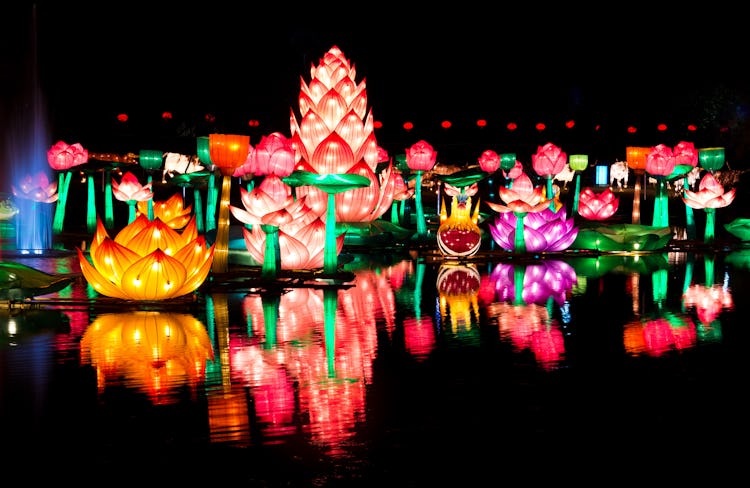
Throughout history, countless variations of lanterns have been created. They can be small globes that fit in your palm, or as large as a parade float. People make lanterns in symbolic designs as well.
When you visit a celebration, you might see giant fish, lotuses or dragons.
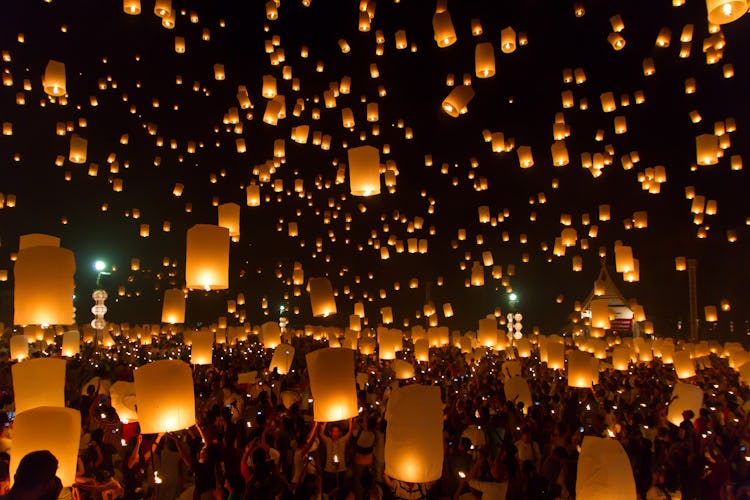
A famous variation is the Kongming lantern (孔明灯—kǒng míng dēng). They represent hope, success and happiness. In the past, people used these lanterns to signify they were safe after an attack.Now, they are used for wishes.
Also known as the sky lantern (天灯—tiān dēng), it sounds similar to 添丁 (tiān ding), which means “adding children”. Lanterns would be gifted to newlyweds or couples without children to pass on the blessings. Pregnant women would receive a pair of small lanterns to wish health and safety on both mother and child.
Some regions also burn lanterns to determine the gender of their future child from the shape of the ashes.

Traditions and Activities

Every holiday has its own set of activities. There’s more to this festival than lanterns!
In the city of Fengyang, swings play a major role. A popular saying there is, “Swing on the Lantern Festival, no aches or pains the entire year.”
One of the festival sights in Hebei are the jǐng xíng lā huā (井陉拉花) performances. Holding fans and parasol-like props, folks dance to the beat of drums.
It’s an energetic and colorful dance that hundreds crowd around to watch.

Lantern riddles (猜灯谜—cāi dēng mí)

The ancient Chinese would often get together with some friends, drink wine and write poetry. Plays on words and riddles were a favorite pastime.
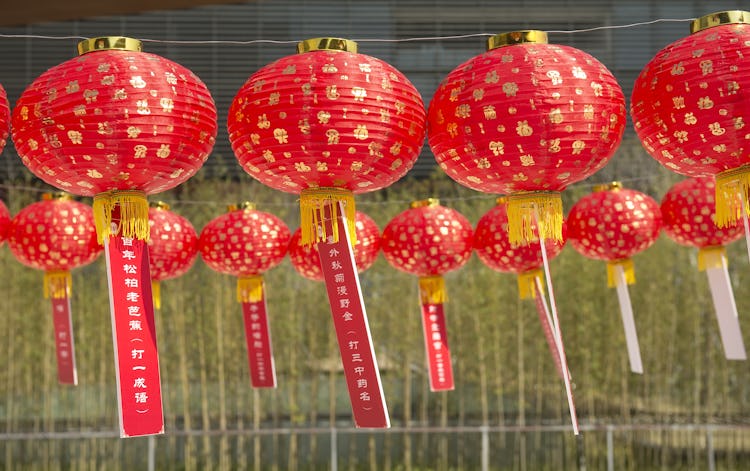
During this festival, people would write riddles on the lanterns. These small games are popular with everyone. They require you to be clever and think outside the box.
According to many love stories, you can catch the attention of your crush through this game!
Modern riddles with dangling from red lanterns.

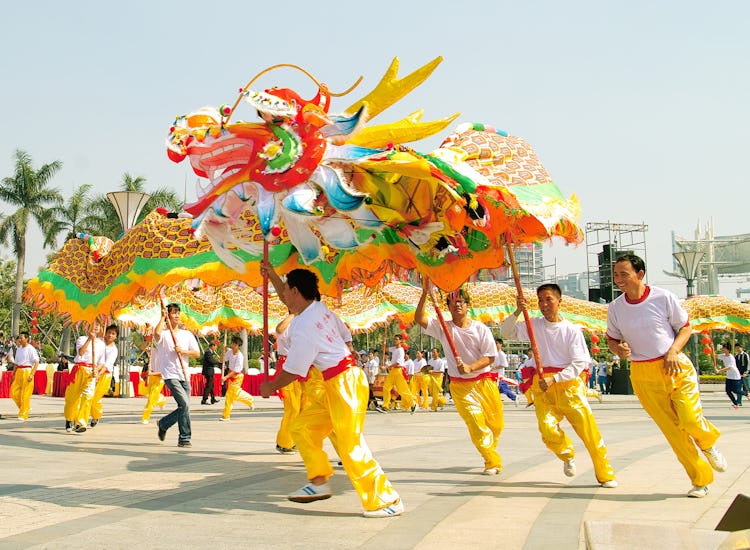
Dragon dance (耍龙灯—shuǎ lóng dēng)

Dragon dance has a history almost as long as Chinese culture itself.
The performers create impressive formations to the beat of Chinese drums and cymbals.
Details show the dragon’s expression and scales on its body.

Lion dance (舞狮子—wǔ shī zǐ)

Lion dances can be seen in any festive event, from holidays to weddings and store openings.
The lion is intricately designed, with movable eyes and mouths. Sometimes, the lion will open its mouth and demand food and red pockets. Other times, they roll around and play like oversized kittens.
Each lion is operated by 2 performers, one as the head and one as the body.

Stilts (踩高跷—cǎi gāo qiāo)

Chinese stilt performances are an ancient act. They stem from Chinese opera and the performers sing and dance while on stilts. Depending on their character, they have difference costumes and heights.
Even on stilts as high as 3 meters, these skilled acrobats can still perform jumps and flips.

Food and Family

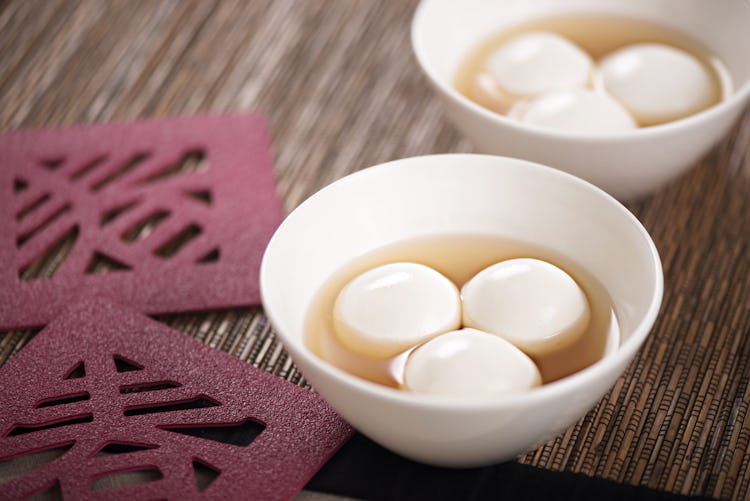
The trademark food of the Lantern Festival is called yuan xiao, just like the festival itself. It’s also known as tāng yuan (汤圆) in the South, and one of the many tasty Chinese New Year desserts.
They are glutinous rice dumplings with sweet fillings made of syrup, red bean paste, black sesame paste or more. They can be steamed or fried, but usually boiled and served in hot water.
They represent family reunions because tang yuan sounds similar to “reunion” (团圆—tuán yuan). Some businessmen also call these balls 元宝 (yuán bǎo), meaning gold or silver ingots.
Yuan xiao resemble full moons and represent reunions.
Despite being a night of revelry, the Lantern Festival is also a night for families. Before Chinese New Year finally ends, the family should reunite again. Take a break from the celebrations and relax with your family. Reconnect under the moon. Enjoy firework shows and performances while eating a bowl of yuan xiao.
Source: https://chinesenewyear.net/lantern-festival/

Tainan Wu Garden 臺南吳園

Address: No. 30, Section 2, Minquan Road, West Central District, Tainan City, 700
 
Wu Garden Building


Wu's Garden

In 1829, a Tainan businessman by name of Wu, Shan Hsin establish-ed such garden, with the top scenery of whole Taiwan, the rock garden, pool, cave. pavilion,... etc., assembling the most natural environment. Up to early of the 20th century, the Scholars and gentry always gathered here for singing songs, chanting the poem, playing music. thus madethe garden quite famous In early of Japanese Colonial Period, the Wu's Garden rivaled with the Lin's Garden in Panchao, the Northern Kou's Garden in Hsinchu, and the Lai's Garden in Taichung, they have been named The Four Great Famous Gardens in Taiwan". Presently, since the Wu's Garden has been reduced it's scale, there is still a proverb spreading to reveal the wealth and honor of the Wu's Garden. They said May People have the wealth as the Wu's, but he may not have the Wu's buildings; May people have the building as the Wu's. he may not have the wealth as the Wu's."


Tainan Public Meeting Hall

In early Japanese Colonial Period, it lacked a wide space for public meeting in Tainan, in 1910 the local officials and gentry donated money and formed the "Association of Tainan Public Hall" , selected the Wu' s Garden field to establish a public meeting place, 1911 a modern building was erected. It was the first place with the function of public meeting in Taiwan. The front main part including a two-story building and an extra one floor building at the west side, the surface of the two-story building is a symmetrical design, assembled by a central entrance and two side doors, reinforced by brick construction. The main hall is located at the rear part, imitated from the occidental Basilica church layout, including the meeting space, corridors on both sides, and the basement. The Tainan Public Meeting Hall has been renamed several times; finally the Tainan Society Education Hall was located here. 1998 it has been listed as the city-grade historic site.